Updated 2026-10-22
How to Plan a Year-Round Blooming Garden in Zone 8 (Pacific Northwest)
In the maritime Pacific Northwest, the Portland/Vancouver area and much of Southwest Washington sit in USDA zone 8b, with 8a in some outlying areas. Mild, wet winters mean a garden here doesn't have to go dark from December to March. If you pick plants by when they flower, rather than only by how they look at the nursery, you can have something blooming in nearly every month.
This guide walks through a four-season plant lineup, gives typical bloom months, covers the soil and siting points that matter most west of the Cascades, and flags which plants are toxic to pets.
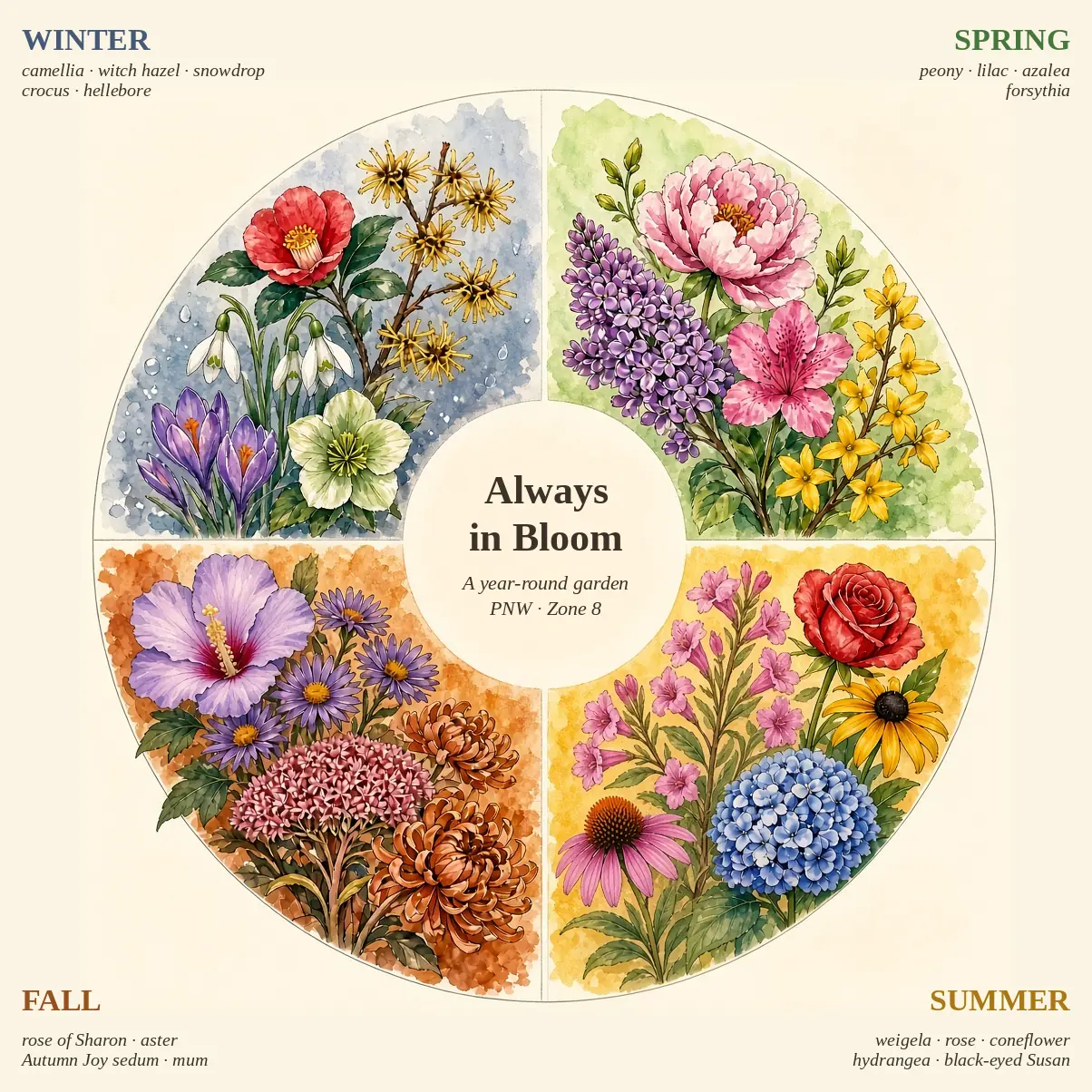
How to plan a garden that blooms all year
A year-round garden is a relay. Each plant hands off to the next, so the planning question is "what's flowering in each month?" A simple way to plan:
- List the months, December through November.
- Fill the gaps first. Winter and late summer are the months most gardens skip.
- Overlap your handoffs. Choose at least two plants for each season so one late or early year doesn't leave a hole.
- Group by site needs. Acid-loving shrubs together, sun-loving perennials together.
About these months: they're approximate. Pacific Northwest timings come from Washington State University (WSU) and Oregon State University (OSU) Extension. Where no PNW source was available, general timings come from the Missouri Botanical Garden (St. Louis) or NC State. Bloom in western Washington and Oregon can run several weeks earlier or later depending on the year, the cultivar and your microclimate. A south-facing wall, a frost pocket, or a windy hilltop can each shift timing noticeably.
Zone 8 flowering plants by season: bloom table
| Season | Plant | Typical bloom (approx.) | Pets (ASPCA) |
|---|---|---|---|
| Winter | Witch hazel (Hamamelis × intermedia) | Late Dec to early Feb; full bloom Jan to early Feb | Not listed by ASPCA |
| Winter | Snowdrop (Galanthus nivalis) | Starts in January | Not listed by ASPCA |
| Winter | Hellebore / Lenten rose (Helleborus × hybridus) | Some from Dec; most Jan to Feb, into spring | Toxic to dogs, cats, horses |
| Winter | Camellia (Camellia japonica) | Late winter to spring, about Jan to Apr | Non-toxic per ASPCA |
| Late winter | Crocus (Crocus vernus) | About Feb to Mar | Not listed by ASPCA |
| Spring | Forsythia (F. × intermedia) | About Mar to Apr | Non-toxic per ASPCA |
| Spring | Azalea (Rhododendron) | About Apr to May (varies by type) | Toxic to dogs, cats, horses |
| Spring | Lilac (Syringa vulgaris) | About May | Not listed by ASPCA |
| Late spring | Peony (Paeonia lactiflora) | Approximately May to early June | Toxic to dogs, cats, horses |
| Late spring | Weigela (W. florida) | About Apr to Jun; may rebloom lightly | Not listed by ASPCA |
| Summer | Rose (Rosa) | Early summer on; many repeat to fall | Non-toxic per ASPCA (thorns can injure) |
| Summer | Bigleaf hydrangea (H. macrophylla) | About Jul to Aug | Toxic to dogs, cats, horses |
| Summer | Coneflower (Echinacea purpurea) | About Jun to Sep | Not listed by ASPCA |
| Summer | Black-eyed Susan (Rudbeckia hirta) | About Jul to Sep | Not listed by ASPCA |
| Late summer | Rose of Sharon (Hibiscus syriacus) | About Jul to Sep | Non-toxic per ASPCA |
| Fall | New England aster (Symphyotrichum novae-angliae) | About Aug to Sep | Not listed by ASPCA |
| Fall | Autumn Joy sedum (Hylotelephium 'Herbstfreude') | Late summer to fall | Not listed by ASPCA |
| Fall | Garden mum (Chrysanthemum × morifolium) | Sep to frost | Toxic to dogs, cats, horses |
Winter blooming plants for the Pacific Northwest
Winter is where a Pacific Northwest garden can stand out. WSU Extension's "Winter Gardens" describes witch hazel tassels from late December, with full bloom in January and early February. Many cultivars are intensely fragrant; 'Jelena' (coppery flowers) and 'Diane' are popular choices. Snowdrops emerge in January, and hellebores flower from December to February. WSU calls hellebores "an amazing perennial for our climate," but notes they need some sun, because dense shade means few flowers. Camellias carry color from late winter into spring, and crocus bridges into early spring. If you want fall and winter color, OSU's EM 9277 also covers sasanqua camellia (C. sasanqua), which blooms in fall and winter.
Spring: zone 8 flowering shrubs take over
Forsythia usually opens the season with yellow, followed by azaleas and lilacs and then peonies in late spring. Two caveats: peonies need a cold winter dormancy and perform best in zones 5–7, though they often do well in northern zone 8 (Missouri Botanical Garden). The Missouri Botanical Garden lists lilac's hardiness as zones 3–7, yet lilacs are widely grown around Portland and Vancouver. Watch your own site before investing heavily.
Summer: carry the color
Weigela links late spring to summer. Roses, many of which repeat-bloom into fall, carry the season along with hydrangeas. Coneflower and black-eyed Susan keep color going into September.
Fall: finish strong
Rose of Sharon runs from about July to September, then New England aster and Autumn Joy sedum, whose flower heads age from pink to bronze. Garden mums bloom from September until frost. NC State notes New England aster's flowers attract late-summer bees and butterflies.
PNW soil and siting for a four-season garden
- Acid soil for azaleas and camellias. WSU Extension (C117) says rhododendrons and azaleas need acidic soil, preferably pH 4.5–5.5, and don't tolerate alkaline soil. Lime leaching from concrete foundations, mortar and driveways can raise pH nearby, so site them away from those areas. OSU Extension publishes guidance on acidifying soil west of the Cascades. Camellias also prefer acid soil and part shade.
- Hydrangea color follows pH. Per OSU Extension, only bigleaf and mountain hydrangeas shift color. Blue needs acidic soil (about pH 5.5 or lower) and available aluminum; pH 5.5–6.5 tends toward purple, and 6.5 or higher toward pink. Garden sulfur lowers pH and lime raises it. High-phosphorus fertilizer can block bluing.
- Roses and wet springs. WSU HortSense notes black spot thrives when leaves stay wet. Water in the morning and avoid overhead watering. Space and prune for air flow, and remove and destroy infected and fallen leaves rather than composting them. WSU publication C158 lists disease-resistant cultivars.
- When to plant. OSU Extension calls mid-September through mid-November an excellent window to plant trees, shrubs and perennials, because soils stay warm and autumn rains help. Plant crocus and snowdrop bulbs in fall. Plant bare-root peonies in late summer or early fall, with the eyes 1–2 inches below the soil surface and no deeper than 2 inches (Iowa State; UW-Madison). Plant hardy garden mums in spring, after the last killing frost, so roots establish before winter (Iowa State; USU).
A note on pets
Azalea, hellebore, peony, hydrangea and garden mum are listed as toxic to dogs, cats and horses by the ASPCA (ASPCA's peony and hydrangea entries are written for related species, Paeonia officinalis and Hydrangea arborescens). Several other plants here have no ASPCA entry, which isn't the same as being safe. Don't confuse spring crocus with autumn crocus (Colchicum), which ASPCA lists as toxic to dogs, cats and horses, with severe signs such as bloody vomiting and organ damage. If pets graze on plants, check the ASPCA Animal Poison Control list (888-426-4435) before planting.
Plan it in Homesteader
Once you've picked your lineup, map each bed on the Homesteader property canvas so you can see where the acid-loving shrubs, sunny perennials and winter bloomers go. Add plants from the plant catalog, then use the planting calendar and recurring care tasks to keep track of fall bulb planting, pruning and pH checks.
FAQ
What blooms in winter in zone 8? In the maritime Pacific Northwest, witch hazel blooms from late December to early February, snowdrops start in January, hellebores flower from December to February, and camellias carry color from late winter into spring, about January to April. Crocus bridges into early spring, about February to March.
Which of these plants are toxic to pets? Azalea, hellebore, peony, hydrangea and garden mum are listed as toxic to dogs, cats and horses by the ASPCA. Several other plants here have no ASPCA entry, which isn't the same as being safe.
When should I plant peonies? Plant bare-root peonies in late summer or early fall, with the eyes 1–2 inches below the soil surface and no deeper than 2 inches (Iowa State; UW-Madison).
When is the best time to plant shrubs and perennials in the PNW? OSU Extension calls mid-September through mid-November an excellent window to plant trees, shrubs and perennials, because soils stay warm and autumn rains help.
Why aren't my hydrangeas blue? Per OSU Extension, only bigleaf and mountain hydrangeas shift color. Blue needs acidic soil (about pH 5.5 or lower) and available aluminum; pH 5.5–6.5 tends toward purple, and 6.5 or higher toward pink. High-phosphorus fertilizer can block bluing.
Sources
- WSU Extension, "Winter Gardens" (2020): https://wpcdn.web.wsu.edu/extension/uploads/sites/57/2020/03/Winter-Gardens.pdf
- WSU Extension C117, "Rhododendrons": https://wpcdn.web.wsu.edu/extension/uploads/sites/44/2025/10/C117-Rhododendrons-2025.pdf
- WSU HortSense, Rose: Black spot: https://hortsense.cahnrs.wsu.edu/fact-sheet/rose-black-spot/
- WSU C158, Rose Cultivars and Disease Resistance: https://s3.wp.wsu.edu/uploads/sites/2076/2024/07/C158-Rose-Cultivars-and-Disease-Resistance.pdf
- WSU PNW Plants, western azalea: https://pnwplants.wsu.edu/PlantDisplay.aspx?PlantID=749
- OSU Extension EM 9277, Trees and Shrubs for Fall and Winter Bloom: https://extension.oregonstate.edu/catalog/em-9277-trees-shrubs-fall-winter-bloom
- OSU Extension, Hydrangeas: https://extension.oregonstate.edu/es/node/110746/printable/print
- OSU Extension, Acidifying soil for rhododendrons and azaleas: https://extension.oregonstate.edu/news/how-acidify-soil-rhododendrons-azaleas-other-acid-loving-plants
- OSU Extension, Fall planting: https://extension.oregonstate.edu/news/fall-planting-offers-long-term-benefits-trees-shrubs-perennials
- OSU Extension, Plant spring-blooming bulbs in fall: https://extension.oregonstate.edu/news/plant-spring-blooming-bulbs-fall-years-low-maintenance-color
- Missouri Botanical Garden Plant Finder: https://www.missouribotanicalgarden.org/PlantFinder/
- NC State Extension Gardener Plant Toolbox: https://plants.ces.ncsu.edu/
- RHS plant pages: https://www.rhs.org.uk/plants/
- Cambridge University Botanic Garden, Autumn Joy: https://www.botanic.cam.ac.uk/the-garden/plant-list/sedum-spectabile-x-sedum-telephium-autumn-joy/
- Ohio State PlantFacts, Hibiscus syriacus: https://plantfacts.osu.edu/tmi/Plantlist/hi_iacus.html
- Iowa State Yard and Garden, "When is the best time to plant peonies?": https://yardandgarden.extension.iastate.edu/faq/when-best-time-plant-peonies
- Iowa State Yard and Garden, "Growing Chrysanthemums in Iowa": https://yardandgarden.extension.iastate.edu/how-to/growing-chrysanthemums-iowa
- UW-Madison Extension, Wisconsin Horticulture, "Peony": https://hort.extension.wisc.edu/articles/peony/
- USU Extension, "Growing Chrysanthemums in the Home Garden": https://extension.usu.edu/yardandgarden/research/growing-chrysanthemums-in-the-home-garden
- ASPCA Toxic and Non-Toxic Plants: https://www.aspca.org/pet-care/animal-poison-control/toxic-and-non-toxic-plants
- rose: https://www.aspca.org/pet-care/animal-poison-control/toxic-and-non-toxic-plants/rose
- rose of Sharon: https://www.aspca.org/pet-care/animal-poison-control/toxic-and-non-toxic-plants/rose-sharon
- camellia: https://www.aspca.org/pet-care/animal-poison-control/toxic-and-non-toxic-plants/camellia
- forsythia (Golden Bells): https://www.aspca.org/pet-care/animal-poison-control/toxic-and-non-toxic-plants/golden-bells
- azalea: https://www.aspca.org/pet-care/animal-poison-control/toxic-and-non-toxic-plants/azalea
- hellebore: https://www.aspca.org/pet-care/animal-poison-control/toxic-and-non-toxic-plants/hellebore
- peony: https://www.aspca.org/pet-care/animal-poison-control/toxic-and-non-toxic-plants/peony
- hydrangea: https://www.aspca.org/pet-care/animal-poison-control/toxic-and-non-toxic-plants/hydrangea
- chrysanthemum: https://www.aspca.org/pet-care/animal-poison-control/toxic-and-non-toxic-plants/chrysanthemum
- autumn crocus: https://www.aspca.org/pet-care/animal-poison-control/toxic-and-non-toxic-plants/autumn-crocus